
Learn the differences between Data Analysts, Data Scientists, and Data Engineers, including their roles, responsibilities, and required skills in the modern data landscap
Introduction
In the era of big data, roles related to data processing and analysis are increasingly in demand across various industries. Three common professions in the data field are Data Analyst, Data Scientist, and Data Engineer. Although all three work with data, each has distinct roles, responsibilities, and skill sets.
Understanding the differences between Data Analyst, Data Scientist, and Data Engineer is essential, especially for students or professionals who want to pursue a career in the data field.
What is a Data Analyst?
A Data Analyst is a professional responsible for processing and analyzing data to generate insights that can be used for business decision-making.
Main responsibilities of a Data Analyst:
- Collecting and cleaning data
- Analyzing data using tools such as Excel, SQL, or Python
- Creating data visualizations (dashboards, charts)
- Preparing reports based on analysis results
Data Analysts typically focus on historical data to answer questions like “what happened?”.
What is a Data Scientist?
A Data Scientist has a more complex role compared to a Data Analyst. They not only analyze data but also build predictive models using machine learning.
Main responsibilities of a Data Scientist:
- Processing large-scale data
- Building machine learning models
- Conducting experiments and evaluating models
- Interpreting advanced analytical results
Data Scientists focus on questions like “what will happen?” and “how can we optimize it?”.
According to research by Telkom University in the Information Systems Journal (2023), the role of Data Scientists is crucial in developing AI-based systems in Indonesia.
What is a Data Engineer?
A Data Engineer is a professional responsible for building and managing data infrastructure. They ensure that data is accessible, stored, and processed efficiently.
Main responsibilities of a Data Engineer:
- Building data pipelines
- Managing databases and data warehouses
- Integrating data from various sources
- Maintaining data quality and security
Data Engineers focus more on “how data is collected and processed” before it is used by Data Analysts or Data Scientists.
Differences Between Data Analyst, Data Scientist, and Data Engineer
Here are the key differences among the three roles:
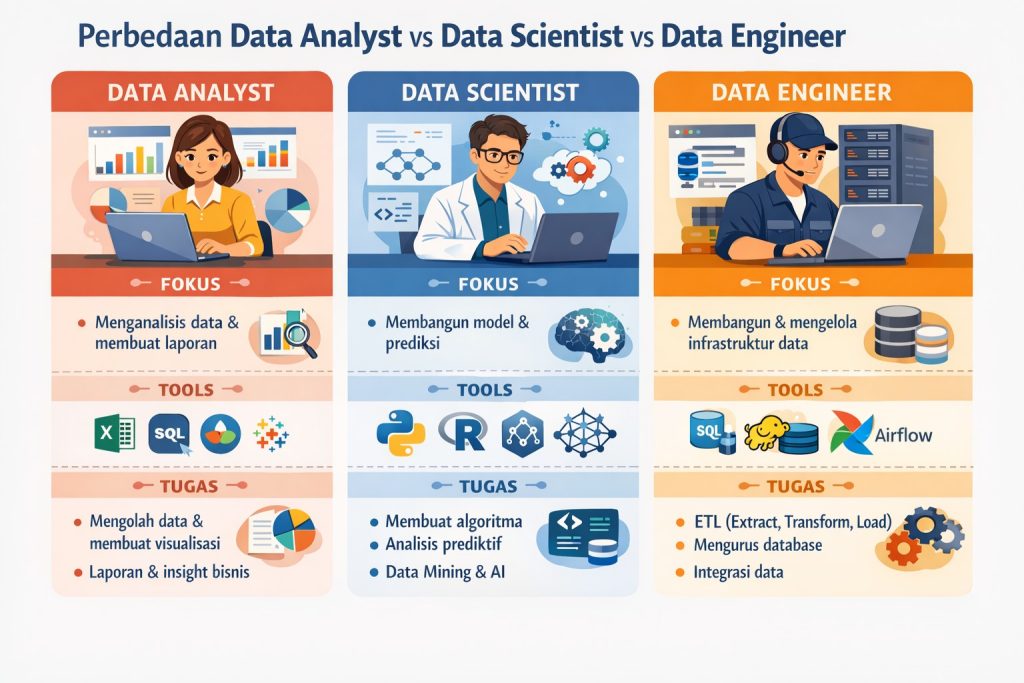
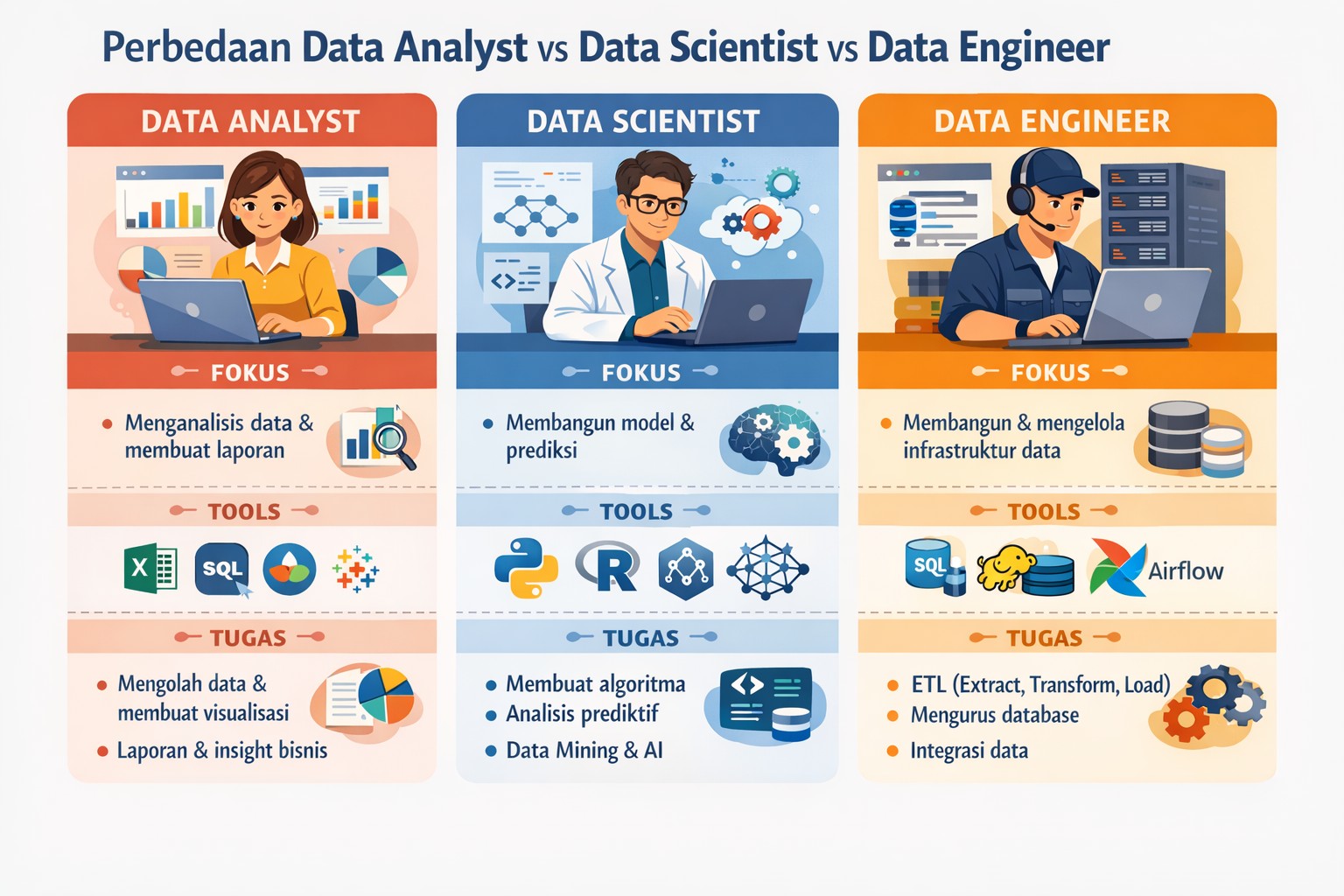
1. Work Focus
Data Analyst: Historical data analysis
Data Scientist: Prediction and machine learning models
Data Engineer: Data infrastructure and pipelines
2. Required Skills
Data Analyst: SQL, Excel, data visualization
Data Scientist: Python, machine learning, statistics
Data Engineer: Big data tools, ETL, databases
3. Tools Used
Data Analyst: Tableau, Power BI
Data Scientist: Python, R, TensorFlow
Data Engineer: Hadoop, Spark, Airflow
4. Main Objective
Data Analyst: Business insights
Data Scientist: Prediction and optimization
Data Engineer: Data availability and quality
Collaboration in Data Teams
These three roles complement each other within a data ecosystem:
- Data Engineers prepare and manage data
- Data Analysts analyze data and create reports
- Data Scientists build predictive models
This collaboration enables organizations to maximize the value of their data.
According to research by Dr. Budi Santosa in the Informatics Journal of Telkom University (2022), integrating these three roles can improve data processing efficiency by up to 35% in enterprise systems.
Career Opportunities in Data
The demand for data-related professions continues to grow both in Indonesia and globally. Some career opportunities include:
- Data Analyst
- Data Scientist
- Data Engineer
- Business Intelligence Analyst
- Machine Learning Engineer
With the advancement of technologies such as AI and big data, the need for data professionals will continue to increase.
Challenges in the Data Field
Despite its promising prospects, the data field also presents several challenges:
- Massive data volume
- Inconsistent data quality
- Complex skill requirements
- Rapid technological changes
Therefore, continuous learning is key to success in a data career.
Conclusion
Data Analysts, Data Scientists, and Data Engineers have different but complementary roles in data processing. Data Analysts focus on analysis, Data Scientists on prediction, and Data Engineers on data infrastructure.
Understanding these differences helps individuals choose the right career path in the data field. With rapid technological advancements, these three professions will continue to play a vital role in digital transformation.
References
- Santosa, B., “Analysis of the Role of Data in Information Systems,” Informatics Journal of Telkom University, 2022.
- Telkom University, “The Development of Data Science in Indonesia,” Information Systems Journal, 2023.
- Provost, F., & Fawcett, T., “Data Science for Business,” O’Reilly Media, 2013.
Author : Anindya Lareina | Intern Puti