Telkom University Information Security Policy
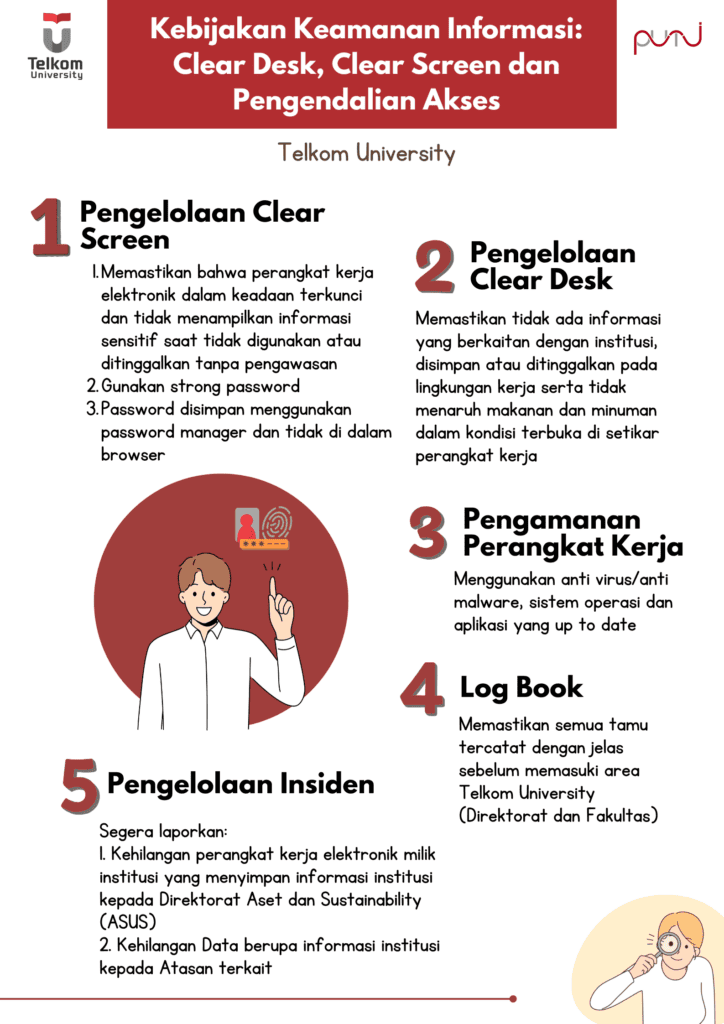
In an effort to maintain information security, Telkom University implements Clear Desk, Clear Screen, and Access Control policies . These policies aim to protect important institutional data and ensure a safe work environment.
- Clear Screen
- Make sure work devices are locked when not in use.
- Use a strong password.
- Store passwords using a password manager, not in a browser.
- Clear Desk
- Avoid storing institutional documents openly.
- Do not leave food and drinks around the work area.
- Device Security
- Use antivirus software and keep your system updated.
- Guest Recording (Log Book)
- All guests must be registered before entering the campus area, especially in the directorates and faculties.
- Incident Handling
- Immediately report any loss of device or institutional data to the appropriate authorities.
Tips to Protect Your Personal Data
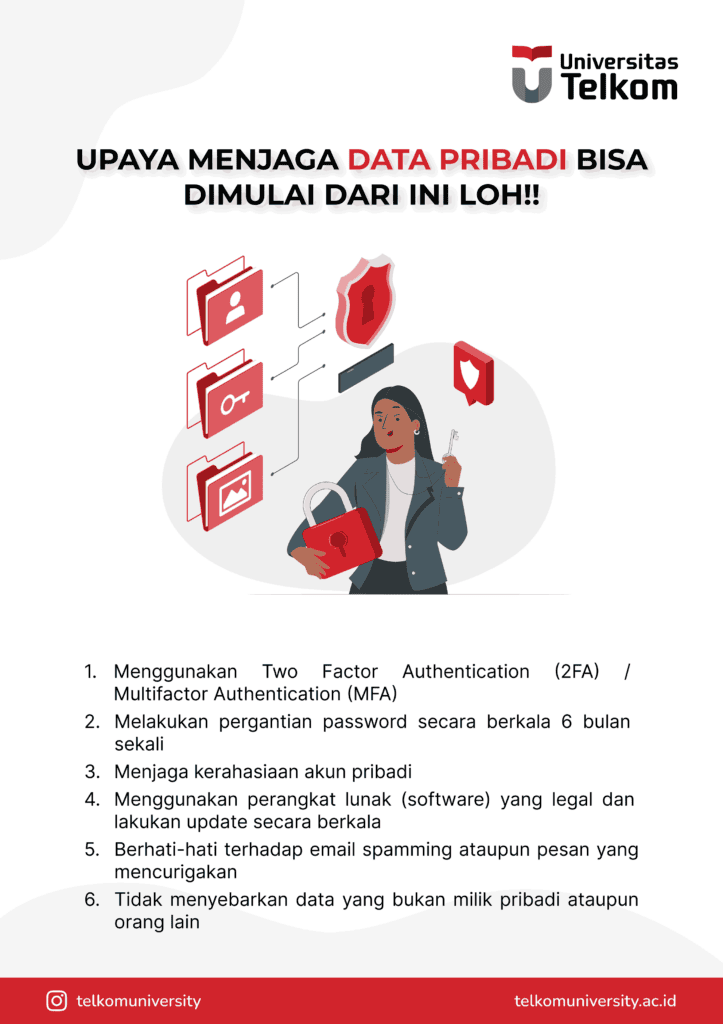
In today’s digital era, maintaining the security of personal data is very important. Telkom University provides guidance for all academics to protect their personal information from cyber threats. Here are some steps that can be taken:
- Enable Dual Authentication (2FA/MFA) to increase account protection.
- Change your password regularly , at least every 6 months, to avoid the risk of data leaks.
- Keep account information confidential by not sharing credentials with anyone.
- Use official software and always update it to keep your system safe from security holes.
- Beware of spam emails and suspicious messages that could potentially be phishing attempts.
- Avoid sharing other people’s personal information or data without permission to maintain privacy and security.
By implementing this policy, Telkom University is committed to maintaining data security and creating a safer working environment for all academicians.
Information Security Policy (Internal Directorate of PuTI)
Document Number: 1136/SKK/0.0/0.0/PuTI/2026 (Revision 7.1)
Effective Date: 26 October 2026
In order to maintain operational integrity, reliability of information technology services, and protection of all university information assets, the Directorate of Information Technology Center (PuTI) has established an Information Security Policy (Revision 7.1) .
This policy is based on the international standard SNI ISO /IEC 27001:2022 by implementing the Plan-Do-Check-Act (PDCA) cycle to ensure the three main pillars of information security: Confidentiality , Integrity , and Availability .This document serves as a standard reference and guide for all internal personnel of the PuTI Directorate in managing, operating, and securing IT infrastructure within Telkom University..
Key Points
Before accessing the complete policy document, all PuTI internal personnel are required to understand and implement the following key aspects.:
1. ISO/IEC 27001:2022 Governance & Standards
- Continuous implementation of the PDCA framework through periodic risk assessments, annual internal audits, and management reviews to mitigate cyber threats.
- Segregation of duties and restriction of administrator access rights specifically for authorized administrative work.
2. Asset Classification & Information
Information assets are grouped into three levels of classification that determine the standards for their treatment and security.:
- Confidential: Critical information (such as network topology and IP addresses, penetration test results , administrator logs, performance data) that may only be accessed by authorized parties.
- Internal Information: Procedure documents, risk assessment results, meeting minutes, and operational reports that are distributed only within the internal environment.
- Public Information: Information that is intentionally made available to the general public (such as brochures and public web portals).
3. Access Control & Authentication
- Single Sign-On (SSO) based network and system access with STRONG level password complexity requirements .
- The obligation to update passwords regularly (at least once every 6 months) and a strict prohibition on saving passwords in browsers without the help of an official password manager .
- Restrictions on remote access channels for network devices and servers that must use the secure SSH v2 protocol.
4. Use of Cryptography & Operational Security
- Implementation of strict encryption standards on web services (TLS v1.2 / TLS v1.3), data transfer encryption (SFTP / HTTPS), and VPN tunneling .
- Separation of development , testing , and production environments to eliminate the risk of unauthorized changes.
- Implementation of centralized system log collection ( syslog ) that is protected from unauthorized access.
5. Clean Desk & Clear Screen Policy
- Work devices (computers/laptops/tablets/smartphones) must be automatically locked ( screen saver locked) when left unattended, with a maximum inactivity time limit of 1 minute .
- Neatness of the work desk ( clean desk ) from physical documents or storage media classified as confidential/sensitive.
Document Access Provisions (Internal Restricted)
Access Note:The Information Security Policy Document (1136/SKK/0.0/0.0/PuTI/2026 Rev 7.1) is RESTRICTED (INTERNAL INFORMATION). The complete file can only be accessed by authenticated PuTI Directorate employees and internal staff through the internal document control system.
📌 Login to the spmdms application via SSO to Download the Complete Document (PDF) (Internal PuTI Staff Only)