
Meta Description:
Learn the differences between DevOps and DevSecOps in system development, including concepts, benefits, and implementation to improve application quality and security.
Introduction
In modern system development, speed and quality are two key factors that must be achieved simultaneously. Organizations are required to deliver applications quickly without compromising stability. This is where the DevOps concept emerges as a solution to integrate development and operations teams.
However, with the increasing number of cybersecurity threats, DevOps has evolved into DevSecOps. DevSecOps adds a security aspect to every stage of system development. Therefore, understanding the differences between DevOps and DevSecOps is essential for organizations to choose the right approach.
What is DevOps?
DevOps is a software development approach that integrates development (developers) and operations teams. The main goal of DevOps is to accelerate the development process, improve collaboration, and ensure faster and more stable application delivery.
Key characteristics of DevOps:
- Collaboration between development and operations teams
- Automation of build, testing, and deployment processes
- Continuous Integration and Continuous Delivery (CI/CD)
- Continuous system monitoring
With DevOps, the development lifecycle becomes more efficient and responsive to change.
What is DevSecOps?
DevSecOps is an evolution of DevOps that incorporates security into every stage of system development. In DevSecOps, security is no longer treated as a final step but is integrated from the beginning of the process.
Key principles of DevSecOps:
- Security by design
- Automated security testing
- Integration of security into CI/CD pipelines
- Collaboration between development, operations, and security teams
DevSecOps ensures that applications are not only delivered quickly but are also secure from various threats.
Differences Between DevOps and DevSecOps
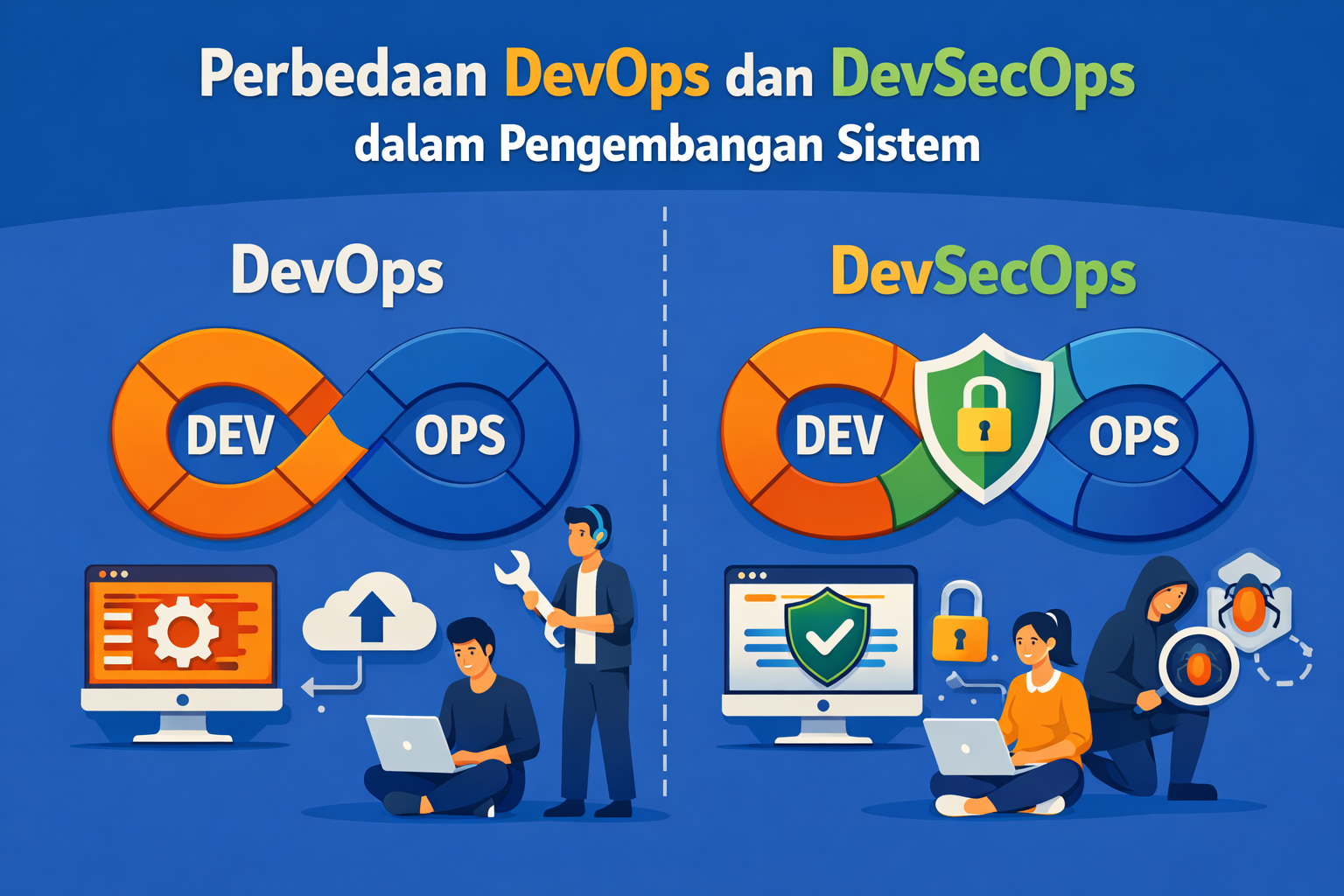
The main differences between DevOps and DevSecOps lie in their focus and approach to system development.
1. Main Focus
DevOps focuses on speed and efficiency in development.
DevSecOps adds a focus on security alongside speed.
2. Security Approach
In DevOps, security is often handled at the end of the process.
In DevSecOps, security is integrated from the beginning through deployment.
3. Team Collaboration
DevOps involves development and operations teams.
DevSecOps involves development, operations, and security teams.
4. Security Automation
DevOps focuses more on deployment automation.
DevSecOps includes automation of security testing such as scanning and vulnerability testing.
5. Security Risk
DevOps may have higher security risks if not properly managed.
DevSecOps reduces risks through a proactive approach.
Implementation of DevOps and DevSecOps
In practice, both DevOps and DevSecOps require appropriate tools and strategies.
Examples of DevOps implementation:
- Use of CI/CD pipelines
- Deployment automation
- Application performance monitoring
Examples of DevSecOps implementation:
- Static Application Security Testing (SAST)
- Dynamic Application Security Testing (DAST)
- Dependency scanning
- Integration of security tools into CI/CD pipelines
With proper integration, DevSecOps can improve both application quality and security.
Advantages of DevOps and DevSecOps
Advantages of DevOps:
- Accelerates development processes
- Improves team collaboration
- Speeds up time-to-market
Advantages of DevSecOps:
- Enhances application security
- Reduces the risk of cyberattacks
- Detects vulnerabilities earlier
- Supports regulatory compliance
DevSecOps provides added value for organizations that prioritize data security.
Challenges in Implementation
Despite their benefits, implementing DevOps and DevSecOps comes with challenges:
- Organizational culture changes
- Lack of skilled professionals
- Complex tool integration
- Implementation costs
However, with the right strategy, these challenges can be addressed gradually.
Conclusion
DevOps and DevSecOps are essential approaches in modern system development. DevOps focuses on speed and efficiency, while DevSecOps incorporates security into every stage of development.
In today’s digital era, where cyber threats are increasing, DevSecOps is a more relevant approach as it integrates security comprehensively. By understanding the differences between DevOps and DevSecOps, organizations can choose the right strategy to build systems that are fast, reliable, and secure.
References
- Humble, J., & Farley, D., “Continuous Delivery: Reliable Software Releases through Build, Test, and Deployment Automation,” Addison-Wesley, 2010.
- Kim, G., et al., “The Phoenix Project: A Novel About IT, DevOps, and Helping Your Business Win,” IT Revolution Press, 2013.
- Behl, A., & Behl, K., “Cybersecurity and Cyberwar: What Everyone Needs to Know,” Oxford University Press, 2017.