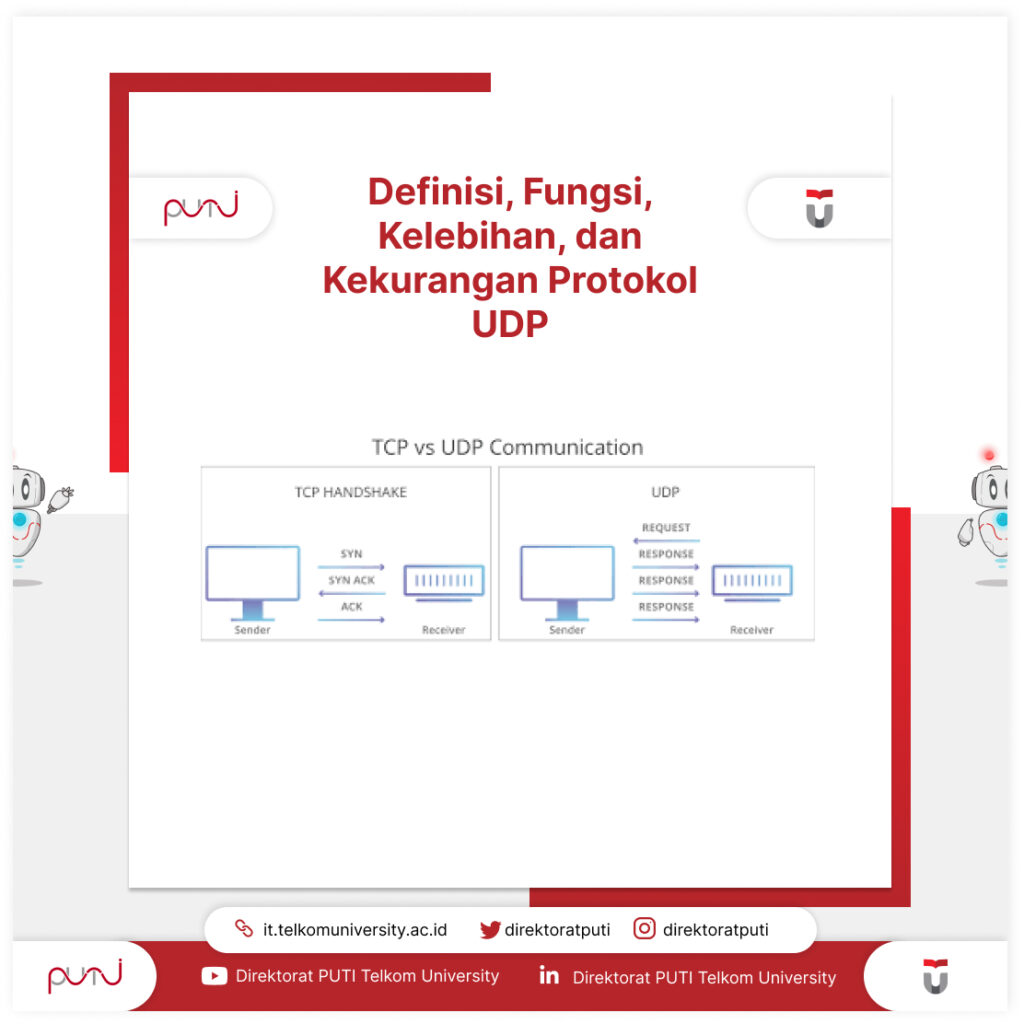


Protocol UDP (User Datagram Protocol) is a transport protocol used in computer network data communication. The UDP protocol is suitable for applications that require high speed and great responsiveness.
Definition of UDP
What is UDP? UDP stands for User Datagram Protocol. UDP is a transport protocol used in data communication over computer networks, especially in time-sensitive data transmission such as video playback and DNS lookup. The UDP protocol allows very fast data transmission but the drawback is that packets are often lost in transit and generate DDoS attacks. UDP Protocol is a datagram-oriented protocol, which means that each message is sent as a separate unit without regard to previous or subsequent messages. UDP operates on top of the IP (Internet Protocol) protocol in the TCP/IP Protocol suite.
UDP Protocol is more suitable for applications that require high speed and responsiveness and little tolerance for data loss or corruption. However, due to its disconnected nature and not ensuring reliable delivery, UDP is less suitable for applications that require reliable and ordered data transfer, such as large file transfer or email protocols.

Function of UDP Protocol
UDP Protocol has several functions in data communication over computer networks. Here are some of the main functions of UDP:
Fast Transfer Data
UDP is designed to provide fast and responsive data transfer. Compared to TCP which has a higher overhead, UDP has no retransmission mechanism or flow settings that slow down the data transmission process. Therefore, UDP is suitable for applications that require high speed, such as media streaming, online gaming, or VoIP.
Peer-to-Peer Communication
UDP supports peer-to-peer communication, where two or more devices can communicate directly with each other without going through a central server. Since UDP does not require prior connection establishment like TCP, peer-to-peer applications can easily use UDP to exchange information directly between the devices involved.
Multicasting and Broadcasting
UDP mendukung fitur multicast dan broadcast. Dalam multicasting, satu pesan dapat dikirim ke banyak tujuan dalam satu operasi pengiriman. Ini berguna untuk aplikasi yang ingin mengirim data ke sekelompok penerima secara bersamaan. Dalam broadcasting, pesan dapat dikirim ke semua perangkat di jaringan, yang berguna untuk situasi di mana informasi perlu diterima oleh semua perangkat dalam jaringan.
Bandwidth Limitation
UDP is also used in applications that have bandwidth limitations, such as the Internet of Things (IoT) or network sensors. Since UDP has lower overhead compared to TCP, and does not perform flow management that tends to fill the available bandwidth, it can reduce latency and enable more efficient data transfer in resource-constrained environments.
DNS (Domain Name System)
UDP is used extensively in the DNS Protocol to map domain addresses to their corresponding IP addresses. DNS requests and responses are sent using UDP, which allows DNS requests to be handled quickly and efficiently, especially in scenarios where a quick response is preferred.
It is important to remember that due to its disconnected nature and not ensuring reliable delivery, UDP is not suitable for all types of applications. The use of UDP should be carefully considered based on application needs, data transfer priorities, and existing network conditions.
Also Read : What is SSH
Advantages and Disadvantages of UDP
The following are some of the advantages and disadvantages of the UDP protocol
Advantages of UDP
UDP Protocol has many advantages, among them are
Speed and Responsivity
UDP is a protocol designed to provide fast data transfer. The absence of complex retransmission, flow management, or data sequencing mechanisms like those in TCP makes UDP more responsive. This makes UDP suitable for applications that require high speed and low response time, such as media streaming, online gaming, or real-time applications.
Efficiency
UDP has lower overhead compared to TCP. The absence of mechanisms such as retransmission or flow management that consume additional resources makes UDP more efficient in the use of network resources. This makes it more suitable for networks with bandwidth limitations or resource-constrained environments.
Multicasting and Broadcasting
UDP supports multicast and broadcast features. Multicasting allows sending messages to many destinations at once, while broadcasting allows sending messages to all devices on the network. This feature enables efficient delivery of data to a group of recipients or to all devices in the network simultaneously.
Disadvantages of UDP
UDP Protocol has many disadvantages, among them are
Does Not Guarantee Reliable Delivery
One of the major drawbacks of UDP is that there is no built-in mechanism to ensure reliable data delivery. UDP does not perform automatic retransmissions if data packets are lost, damaged, or arrive out of order. This means that data sent using UDP can be lost or incomplete without any repair or error detection.
Does Not Guarantee Sorted Delivery
UDP also does not guarantee delivery of data in the same order as it was transmitted. Data packets sent over UDP may arrive at the receiver in a different order to the original sending order. If the application requires ordered data delivery, then there needs to be an additional mechanism in the application to manage the order of the received data.
Vulnerable to Data Loss and Damage
Since UDP has no built-in retransmission or error detection mechanisms, data sent over UDP is more susceptible to loss or corruption. This can be a problem in applications that require accurate data delivery, such as large file transfers or email protocols.
Also Read : What is TCP Protocol
Types of UDP
UDP (User Datagram Protocol) is a protocol that is standardized across all implementations and does not have different variations like TCP. Therefore, there are no different “types” of UDP. UDP is a transport protocol used in data communication over computer networks, and its specifications remain consistent across all implementations. However, in the context of using UDP, there are several ways or features that can be used to utilize this protocol. Here are some features that are often used in the use of UDP:
Unicast
Unicast is a type of communication that involves sending a message from a single sender to a single receiver. In the context of UDP, unicast delivery can be done by sending UDP datagrams from one host to another using a specific destination IP address.
Multicast
Multicast is a type of communication that involves sending messages from one sender to many receivers in a single delivery operation. In the context of UDP, multicast delivery can be done by sending a UDP datagram to the specified multicast IP address, so that the datagram will be received by all hosts belonging to the multicast group.
Broadcast
Broadcast is a type of communication that involves sending messages from a single sender to all devices in the network. In the context of UDP, broadcast delivery can be done by sending a UDP datagram to the specified broadcast IP address, so that the datagram will be received by all devices in the network.
Use of Port
UDP Protocol employs the use of ports to identify the application or service that will receive the UDP datagram. The port is used in conjunction with the IP address to direct the datagram to the appropriate application on the receiving host.
It is important to remember that the nature of UDP is that it is unconnected, does not guarantee reliable delivery, and does not guarantee sequential delivery. Therefore, the use of UDP Protocol should be carefully considered based on the application needs and desired communication characteristics.
Discover the advantages and applications of the UDP protocol in modern networks at the Best Private University in Jakarta. Immediately learn more to explore this technology in depth!
References
https://www.cloudflare.com/learning/ddos/glossary/user-datagram-protocol-udp/
Author : Hassan Rizky Putra Sailellah | Editor : Meilina Eka Ayuningtyas
Tags : Kampus Swasta Terbaik di Indonesia | Kampus Swasta di Jakarta | Kampus Swasta di Bandung | Kampus Swasta Terbaik | Kampus Swasta di Surabaya | Universitas Swasta Terbaik di Indonesia | Universitas Swasta di Jakarta | Universitas Swasta di Bandung | Universitas Swasta di Surabaya | Universitas Swasta Terbaik di Jakarta | PTS Terbaik di Indonesia | Universitas Swasta Terbaik | Universitas Terbaik di Bandung