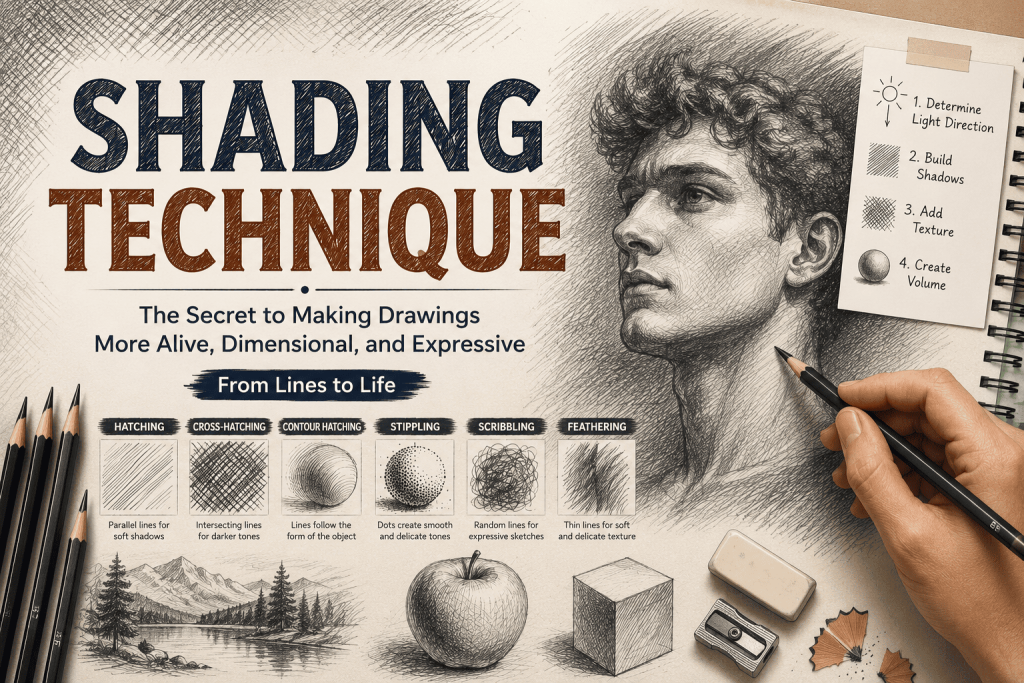

If you enjoy drawing or are currently learning visual arts, you have probably heard the term shading technique.
This method is considered a secret to making drawings look more alive and dimensional. From simple lines, artists can create shadows, textures, dimensions, and volume that make objects appear to jump off the paper. Shading can take the form of straight, diagonal, curved, or intersecting lines. In English, it is commonly known as hatching or cross-hatching.
The purpose is simple: to make objects appear to have volume, indicate the direction of light, and add textures such as roughness or smoothness. Without shading, your drawing would only consist of outlines with no sense of life.
This technique has been used since the Renaissance period, when artists such as Leonardo da Vinci employed it to make paintings more realistic. Today, shading remains a fundamental skill in digital art, even when using software such as Photoshop.
This article will discuss in detail: what shading is, its functions, types, how to create it, examples of drawings, and tips for beginners.
Understanding Shading Techniques in More Detail
In more detail, a shading technique is the process of applying strokes with specific patterns, where dense and closely packed lines are used for dark areas, wider-spaced lines are used for lighter areas, thick lines create a stronger effect, and thin lines produce a softer impression.
Many art books describe shading as the foundation of realism. For example, in the book The Art of Drawing by Giovanni Civardi, shading is explained as a method for simulating light and shadow.
This technique is not only used for static drawings but can also be applied in animation and comic illustrations.
Functions of Shading Techniques: Why Are They Important?
Shading is not only used in art but also in technical design and illustration, such as portrait sketches, anatomy studies, product design, architecture, comics, and industrial design. Its primary functions include:
Creating Shadows
Showing which areas are light and which are dark. This is essential for making drawings appear three-dimensional.
Adding Texture
Such as wood, fabric, skin, or metal. For example, shading can make skin appear smooth or rough.
Creating Volume
Transforming a two-dimensional image into one that appears three-dimensional. Without shading, objects look flat.
Efficient for Quick Sketches
Fast and practical, making it suitable for capturing sudden ideas.
In the professional world, artists who are skilled in shading are highly valued because they can create convincing visuals. Even in the digital era, manual shading skills are still appreciated for concept art.
Types of Shading Techniques: From Hatching to Scribbling
There are several types of shading techniques that you should know, each with its own purpose:
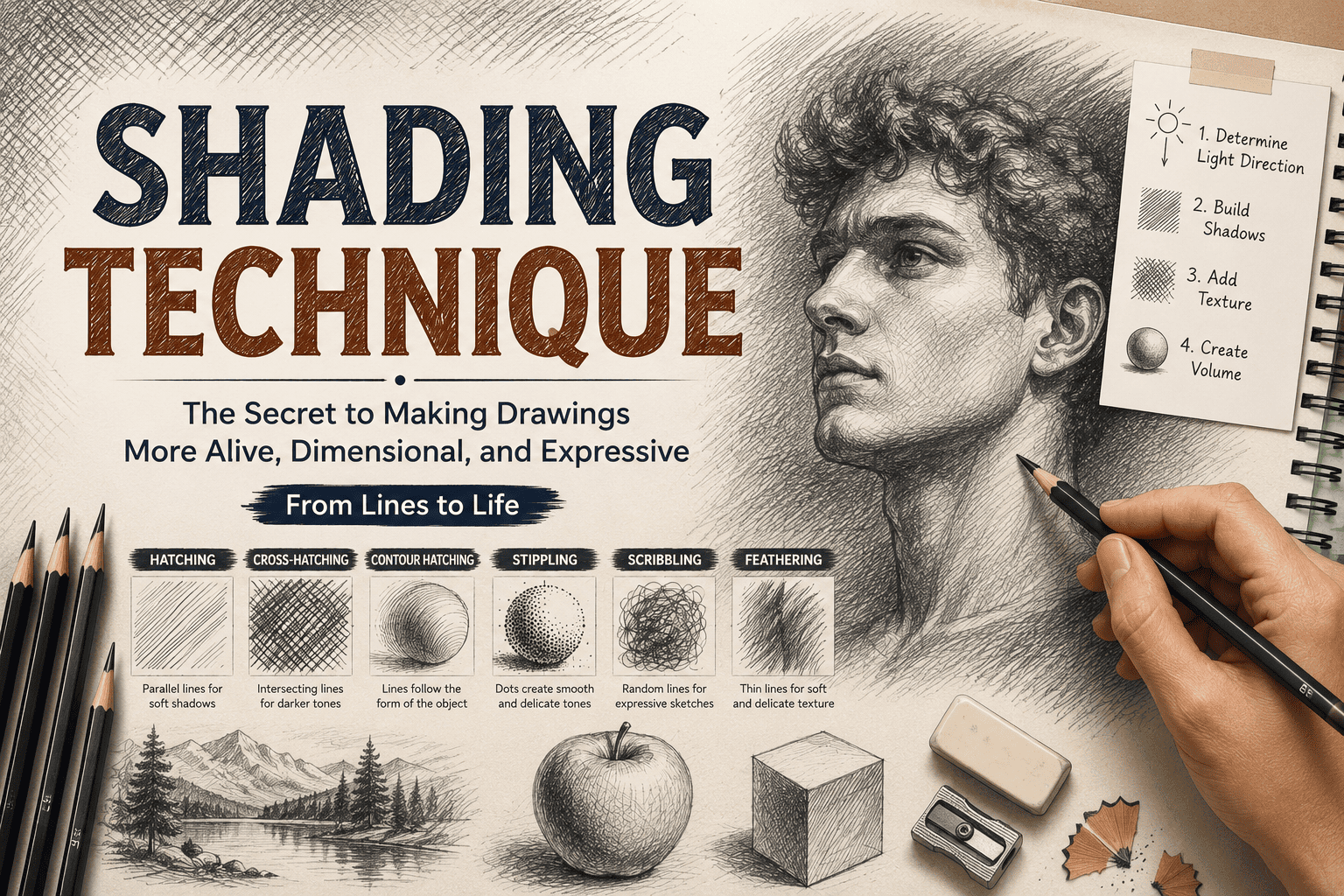
Hatching
Parallel lines arranged in one direction. Suitable for soft shadows, such as gentle sunlight. Commonly used in landscape drawings.
Cross-Hatching
Intersecting lines that create darker areas. Ideal for portraits or dramatic objects, such as nighttime shadows. This technique makes drawings more dynamic.
Contour Hatching
Lines that follow the shape of an object, such as a sphere. It looks very natural and is suitable for organic subjects. Commonly used for drawing fruits.
Stippling
Created using small dots, producing a smooth effect. Suitable for ink illustrations, such as botanical drawings. This technique requires patience, but the results are worth it.
Scribbling
Random and expressive lines. Ideal for quick sketches and spontaneous ideas. Many modern artists use it to create abstract effects.
Feathering
Thin lines resembling feathers, used to create soft textures such as hair. Commonly applied in figure drawing.
Each type has its own unique characteristics, ranging from simple hatching to more complex cross-hatching.
Steps for Creating Shading Techniques
Determine the Direction of Light
Identify the light source and its intensity. This is crucial because shading must follow the direction of light. For example, if the light comes from the left, the shadow will appear on the right.
Hold the Pencil Comfortably
A comfortable grip helps create consistent lines. Avoid pressing too hard to prevent hand fatigue.
Practice Drawing Lines
Create parallel, diagonal, intersecting, and curved lines. This exercise serves as a warm-up and can be done for just five minutes.
Control Pressure
Use light pressure for bright areas and stronger pressure for darker areas. This creates smooth gradations.
Layering
Apply shading gradually by adding layers to achieve the desired effect. Start lightly and build up progressively. This technique adds depth to the drawing.
Keep the Paper Clean
Avoid touching shaded areas. Use tissue paper if necessary.
Examples of Shading Techniques
Hatching
Used for basic shadows, such as on a cube. Parallel lines create a simple lighting effect.
Cross-Hatching
Suitable for detailed portraits. Intersecting lines make facial expressions appear more vivid.
Contour Hatching
Ideal for spheres or anatomical drawings. Curved lines follow the object’s form, creating a very natural effect.
Easy Practice for Beginners
Try shading an apple or a circle. Start with the outline and then add shadows.
Look at the works of professional artists such as Rembrandt for inspiration. They used shading techniques to create timeless classical artworks.
Common Mistakes and Tips for Mastering Shading
1. Mistakes
Inconsistent lines, incorrect pressure, improper light direction, and excessive erasing.
2. Tips
Practice regularly using pencils ranging from HB to 6B, observe real objects and photo references, and maintain consistency because it is the key to improvement. In addition, do not hesitate to experiment, erase, and try again. Pay close attention to surrounding lighting, as it can greatly assist your understanding of shading.
Applications of Shading Techniques: In Education and Industry
1. In Education
Art curricula and drawing assignments often require students to practice shading as a fundamental skill.
2. In Industry
Shading is used in book illustrations, comics, product design, and animation. For example, in Marvel Comics, shading is often used to create dramatic visual effects.
Shading serves as the foundation for many modern visual professions. Even in game design, manual shading skills remain valuable for concept development.
Conclusion
Shading techniques are a fundamental part of drawing, used to create shadows, textures, and volume. Through methods such as hatching, cross-hatching, and others, artists can make drawings appear more realistic. From beginners to professionals, shading is an essential skill to master. If you want to deepen your knowledge of visual arts, visit the Interior Design Undergraduate Program at Telkom University today. Learning shading techniques can help you become more creative and confident.
References
- Situmorang, R. (2020). “Penerapan Teknik Arsir dalam Pembelajaran Seni Rupa.” Jurnal Seni dan Desain, 8(2). https://ejournal.unimed.ac.id/2012/index.php/jsdp/article/view/21051
- Wulandari, D. (2019). “Analisis Teknik Arsir dalam Gambar Ilustrasi.” Jurnal Pendidikan Seni Rupa, 7(1). https://journal.unnes.ac.id/sju/index.php/JSR/article/view/27944
- Pratama, H. (2021). “Efektivitas Teknik Arsir untuk Pembelajaran Shading.” Jurnal Pendidikan Seni, 5(3). https://ojs.unm.ac.id/arts/article/view/21800
- Lestari, N. (2022). “Teknik Menggambar Arsir sebagai Dasar Pembentukan Objek 3D.” Journal of Art & Design Education. https://journal.uny.ac.id/index.php/jpji/article/view/46872
- Tambahan: Civardi, G. (2005). “The Art of Drawing.” Search Press. (Buku klasik tentang teknik arsir.)