



Definition of Internet of Things
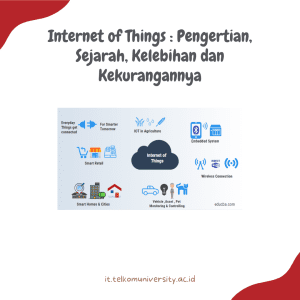
The Internet of Things (IoT) is a concept that refers to a network of physical objects connected to the internet that can exchange data without requiring direct human intervention. In other words, IoT refers to the ability of devices or objects to connect to the internet, collect data, and act based on that data.
Common IoT devices include sensors, cameras, smart lighting systems, automatic doors, and many others. The IoT concept has created significant opportunities for developing smart technology solutions and applications that improve efficiency, convenience, and security in everyday life.
History of Internet of Things
The term Internet of Things (IoT) was first introduced by Kevin Ashton, a British technology pioneer, in 1999 while working at the Auto-ID Center at the Massachusetts Institute of Technology (MIT). He proposed the idea that physical objects could communicate through the internet using embedded sensors, allowing them to connect and interact with other devices.
At that time, IoT was not widely discussed because the supporting technologies were not yet advanced enough to make the concept practical. It was not until the early 2000s, when sensor technologies and wireless networks became more sophisticated, that IoT started to become a reality.
As technology continued to evolve, more companies and developers became interested in IoT applications. This growing interest accelerated the development of IoT solutions, making the technology an essential component of today’s digital era.
Advantages and Disadvantages of Internet of Things
Advantages of IoT
1. Improved Efficiency and Productivity
IoT enables organizations and individuals to enhance efficiency and productivity through real-time data collection and analysis.
2. Enhanced Quality of Life
IoT can help monitor health and safety conditions while connecting users to technologies that improve their daily lives.
3. Better Energy Efficiency
IoT systems can monitor and control energy consumption in buildings and facilities, helping optimize energy usage and reduce waste.
4. Ease of Operation
Connected devices are easier to operate and control through user-friendly mobile or web applications.
5. Better Decision-Making
Real-time data analytics provided by IoT helps organizations and individuals make faster and more informed decisions.
Disadvantages of IoT
1. Security Risks
IoT devices are often targets of cyberattacks, making cybersecurity a significant concern for connected systems.
2. Privacy Concerns
Since IoT devices continuously collect data, personal information may be exposed or misused if it falls into the wrong hands.
3. Complexity
Managing numerous interconnected devices can be challenging, especially for users who are unfamiliar with IoT technologies.
4. High Costs
The development, installation, and maintenance of IoT infrastructure can be expensive, particularly for specialized applications.
5. Dependence on Internet Connectivity
IoT systems rely on stable internet connections. If the connection is interrupted or unstable, device functionality may be affected.
How Internet of Things Works
IoT operates through a combination of internet connectivity and sensor technology. IoT devices are equipped with sensors capable of detecting various types of information, such as temperature, humidity, light levels, and motion.
The collected data is transmitted to a server through the internet. The server processes the information and performs data analysis to generate insights or make decisions. This process is commonly known as analytics.
Once the analysis is completed, the results are sent back to the IoT device, allowing it to perform specific actions automatically.
A simple example is a smart thermostat connected to a heating or cooling system. The thermostat measures room temperature and sends the data to a server. The server analyzes the information and determines whether the heating or cooling system should be activated or deactivated. The decision is then transmitted back to the thermostat to control the system accordingly.
In general, IoT enables devices to communicate and collaborate to achieve specific goals, such as reducing energy consumption, improving production efficiency, and enhancing user comfort.
Benefits of Internet of Things
1. Increased Efficiency and Productivity
IoT allows devices to communicate and interact automatically, resulting in improved efficiency and productivity across industries.
2. Affordability and Accessibility
As IoT technologies continue to evolve, they are becoming more affordable and accessible for businesses of all sizes.
3. Convenience and Comfort
IoT enables remote control and automation of various devices, providing greater convenience in daily activities.
4. Energy Savings
Smart monitoring systems help reduce energy consumption, lower operational costs, and minimize environmental impact.
5. Enhanced Security
IoT can improve security through automated monitoring systems and early threat detection mechanisms.
6. Data and Analytics
IoT generates valuable data that organizations can use for analysis, optimization, and strategic decision-making.
7. Improved Quality of Life
IoT applications in healthcare, smart homes, and environmental monitoring contribute to better living conditions and overall well-being.
Despite these benefits, organizations must also address data security and privacy concerns when implementing IoT technologies.
Conclusion
The Internet of Things (IoT) is a technology concept that connects physical devices to the internet, enabling them to exchange data and operate automatically without direct human intervention. By utilizing sensors, internet connectivity, and data analytics systems, IoT allows devices to collect information, process it, and take appropriate actions.
Since its introduction by Kevin Ashton in 1999, IoT has continued to evolve alongside advancements in sensor technology, networking, and computing. Today, IoT delivers numerous benefits, including improved efficiency, productivity, convenience, and data-driven decision-making across various sectors.
Although IoT offers significant advantages, it also presents challenges such as cybersecurity risks, privacy concerns, implementation costs, and dependence on stable internet connections. Nevertheless, IoT remains one of the most important technologies of the digital age, with tremendous potential to improve quality of life and drive innovation across industries.
References
IEEE Xplore. Internet of Things Research Publications.
IBM. Internet of Things Overview.
SAS. Internet of Things Explained.
Suhendar, A., Pratama, R. A., & Nugraha, D. (2025). Implementation of Internet of Things (IoT) in Hydroponic Melon Cultivation for Export Quality. Indonesian Journal of Community Service and Innovation, 3(1), 45–52.
Author: Anindya Lareina | Magang PuTi