



When people first hear the term “neural network,” it’s natural to picture something straight out of science fiction — a machine literally thinking like a human. The reality is both more modest and more fascinating. Neural networks are mathematical systems loosely inspired by the structure of the human brain, designed to recognize patterns, make predictions, and solve problems that are too complex for traditional rule-based programming. They don’t replicate consciousness or emotion, but they do borrow the brain’s core strategy: learning through interconnected units that strengthen or weaken their connections over time.
The Biological Inspiration Behind Neural Networks
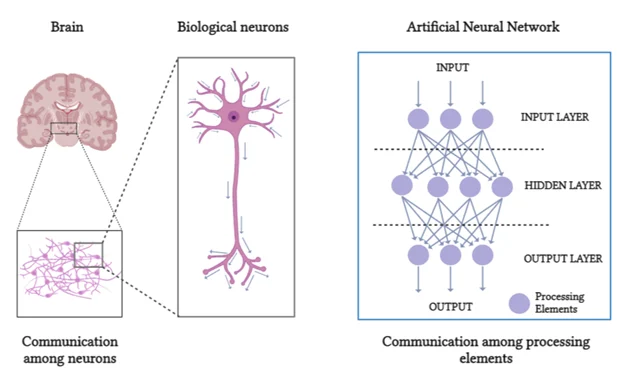
The human brain contains roughly 86 billion neurons, each connected to thousands of others through synapses. When a neuron receives enough electrical and chemical signal from its neighbors, it “fires” and passes the signal onward. Learning happens as these connections are repeatedly strengthened or weakened based on experience — a concept famously summarized as “neurons that fire together, wire together.”
Artificial neural networks borrow this basic blueprint:
- Artificial neurons (nodes) act like biological neurons, receiving inputs and producing an output.
- Weights mimic synaptic strength, determining how much influence one neuron’s signal has on the next.
- Activation functions decide whether a neuron “fires” based on the combined strength of its inputs, similar to a biological firing threshold.
- Layers of neurons stand in for the brain’s layered processing regions, with each layer extracting increasingly abstract information.
It’s important to note that this is an inspiration, not a copy. Artificial neurons are vastly simplified compared to biological ones, and the brain’s learning process involves chemical and structural complexity that current models don’t fully replicate.
How Neural Networks Actually Learn
A neural network learns in a way that echoes trial-and-error learning in humans, though the mechanics are purely mathematical.
- Input layer: Raw data — an image, a sound wave, or a block of text — enters the network.
- Hidden layers: The data passes through multiple layers of neurons, each detecting different features (edges in an image, tone in audio, sentence structure in text).
- Output layer: The network produces a prediction, such as identifying an object or classifying a sentiment.
- Backpropagation: The network compares its prediction to the correct answer, calculates the error, and adjusts its internal weights to reduce that error next time.
This cycle repeats thousands or millions of times until the network’s predictions become reliably accurate. In a real-world demonstration of this process, Supriadi, Rachmawati, and Arifianto (2021), researchers affiliated with Telkom University, built a mobile object-recognition system for early childhood education using a MobileNet-based convolutional neural network combined with a Single Shot Multibox Detector. Their network was trained to recognize everyday household objects from camera images, gradually improving its accuracy as it processed more training examples — a clear illustration of how layered, brain-inspired architectures translate into practical, everyday applications.
Why This “Brain-Like” Design Solves Complex Problems
Traditional computer programs follow rigid, pre-written instructions. They struggle with tasks that involve ambiguity, such as recognizing a face at different angles or understanding sarcasm in a sentence. Neural networks, by contrast, thrive in exactly these situations because of their brain-inspired design.
- Pattern recognition: Like the human visual cortex, convolutional neural networks (CNNs) detect edges, shapes, and textures before recognizing full objects.
- Sequential understanding: Recurrent neural networks (RNNs) and Transformers process information in sequence, similar to how the brain processes language or music over time.
- Generalization: A well-trained network can recognize a cat it has never seen before, just as a child can recognize a new dog breed after seeing only a few examples.
- Parallel processing: Just as the brain processes multiple sensory inputs simultaneously, neural networks can process many data points at once using specialized hardware like GPUs.
This combination of pattern detection, sequence awareness, and generalization is why neural networks now power technologies such as medical image diagnosis, real-time language translation, autonomous vehicles, and voice assistants.
Where the Analogy Breaks Down
While the brain analogy is a useful teaching tool, it has clear limits:
- Artificial neurons use simplified mathematical functions, while biological neurons involve complex electrochemical processes.
- The brain learns continuously and in real time; most neural networks require distinct, separate training phases.
- The human brain uses only about 20 watts of power, while training large neural networks can consume enormous amounts of energy.
- Neural networks lack self-awareness, intuition, or genuine understanding — they recognize statistical patterns, not meaning.
Understanding these limits is just as important as appreciating the similarities, especially for anyone evaluating what AI can and cannot realistically achieve.
Real-World Applications Worth Exploring
Neural networks inspired by the brain’s architecture are already reshaping numerous industries:
- Healthcare: Detecting tumors in medical scans with accuracy comparable to trained radiologists.
- Education: Powering adaptive learning apps and object-recognition tools for early childhood learning.
- Transportation: Enabling self-driving vehicles to interpret road conditions in real time.
- Communication: Driving real-time translation, transcription, and voice recognition tools.
If you’re intrigued by how these systems move from theory into real products, our other articles explore these applications in much greater depth — from how convolutional neural networks power facial recognition to how recurrent architectures enable natural language understanding. Diving into those pieces will help you connect today’s foundational concepts to the tools shaping tomorrow’s technology.
If you want to know more about Artificial Intelligence, read: Macam-macam Artificial Intelligence untuk Kebutuhan Kerja
Conclusion
Neural networks are one of the most powerful tools in modern computing precisely because they borrow — thoughtfully, not literally — from the way the human brain processes information. By organizing artificial neurons into interconnected layers and adjusting the strength of their connections through repeated exposure to data, these systems can detect patterns, make predictions, and solve problems that once seemed uniquely human. Yet they remain fundamentally different from biological brains: simplified, energy-hungry, and devoid of genuine understanding. Recognizing both the inspiration and the limitations is key to using this technology wisely. To keep building your understanding of how these systems work in practice, we encourage you to explore more articles on our website covering the tools, models, and real-world case studies shaping the future of AI.
Frequently Asked Questions (FAQ)
1. Do neural networks actually think like humans?
No. They are inspired by the brain’s structure but rely purely on mathematics and statistics — they do not possess consciousness, emotions, or genuine understanding.
2. Why are neural networks good at solving complex problems?
Their layered, interconnected design allows them to detect patterns and relationships in data that traditional, rule-based programs cannot easily capture.
3. What is the difference between a neuron in the brain and an artificial neuron?
A biological neuron uses complex electrochemical signals, while an artificial neuron is a simplified mathematical function that processes numerical inputs and produces an output.
References
- Supriadi, M. F., Rachmawati, E., & Arifianto, A. (2021). Pembangunan aplikasi mobile pengenalan objek untuk pendidikan anak usia dini. Jurnal Teknologi Informasi dan Ilmu Komputer (JTIIK), 8(2), 357–364. https://doi.org/10.25126/jtiik.202184363 (Corresponding author verified on institutional record, Telkom University, email domain: telkomuniversity.ac.id)
- Goodfellow, I., Bengio, Y., & Courville, A. (2021). Deep Learning: Foundations and Concepts (Updated ed.). MIT Press.
- Géron, A. (2022). Hands-On Machine Learning with Scikit-Learn, Keras, and TensorFlow (3rd ed.). O’Reilly Media.
- Kriesel, D. (2023). A Brief Introduction to Neural Networks (Rev. ed.). Independent Academic Publishing.
- Telkom University Open Library. (2023). Machine Learning dan Deep Learning. Telkom University Press. https://openlibrary.telkomuniversity.ac.id/pustaka/231311/machine-learning-dan-deep-learning.html