



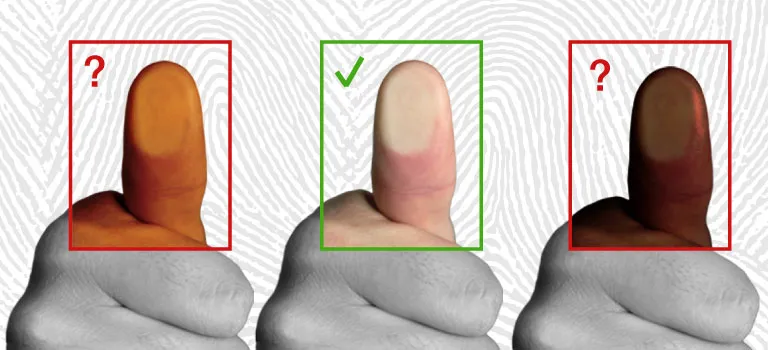
Artificial intelligence is often described as objective — a cold, calculating system free from human emotion or judgment. In reality, AI is only as fair as the data and decisions that shape it. Time and again, real-world AI systems have been found to replicate or even amplify existing societal biases, from resume screening tools that favor certain demographics to facial recognition systems that perform less accurately on darker skin tones. Understanding how this happens is essential for anyone building, deploying, or simply relying on AI-powered systems in daily life.
What Is AI Bias, Exactly?
AI bias refers to systematic and unfair discrimination that emerges in the outputs of a machine learning model. Importantly, this bias isn’t usually the result of a machine “deciding” to be prejudiced — it’s a reflection of patterns baked into the data, design choices, or deployment context of the system.
- Bias is inherited, not invented. AI systems learn from historical data, and if that data reflects past human inequities, the model can reproduce them.
- Bias can be subtle. It doesn’t always look like an obvious error; it can appear as small, consistent differences in accuracy or outcomes across different groups.
- Bias can compound. Once a biased system is deployed at scale, its decisions can reinforce the very inequalities that created the bias in the first place.
How Bias Enters AI Systems
Bias doesn’t appear out of nowhere — it typically enters an AI system through one or more of the following stages:
- Data collection: If historical hiring data mostly reflects one gender or demographic in leadership roles, a model trained on that data may learn to associate that demographic with “success.”
- Data imbalance: When one group or category is significantly underrepresented in a training dataset, the model tends to perform less accurately for that group, since it has “seen” fewer examples to learn from.
- Feature selection: Choosing which variables to include in a model can unintentionally encode proxies for sensitive attributes, such as using zip code as a stand-in for race or income.
- Labeling bias: If human annotators bring their own unconscious biases into labeling training data, those biases transfer directly into the model.
- Deployment context: Even a well-trained model can behave unfairly if it’s used in a real-world setting that differs significantly from its training environment.
This data-imbalance problem is well documented in academic research. Gumilar, Prasetiyowati, and Sibaroni (2022), researchers from Telkom University, demonstrated in a hybrid machine learning study that unbalanced datasets significantly affect classification performance, and that applying resampling techniques meaningfully improved model accuracy and reliability. While their study focused on rainfall classification rather than social bias specifically, it illustrates the same underlying technical principle that drives many real-world AI fairness problems: models trained on skewed or unrepresentative data tend to produce skewed, less reliable outcomes for underrepresented categories.
If you want to learn more about how AI collects data, read: Perplexity AI: Artificial Intelligent Chatbot Technology
Real-World Examples of AI Bias
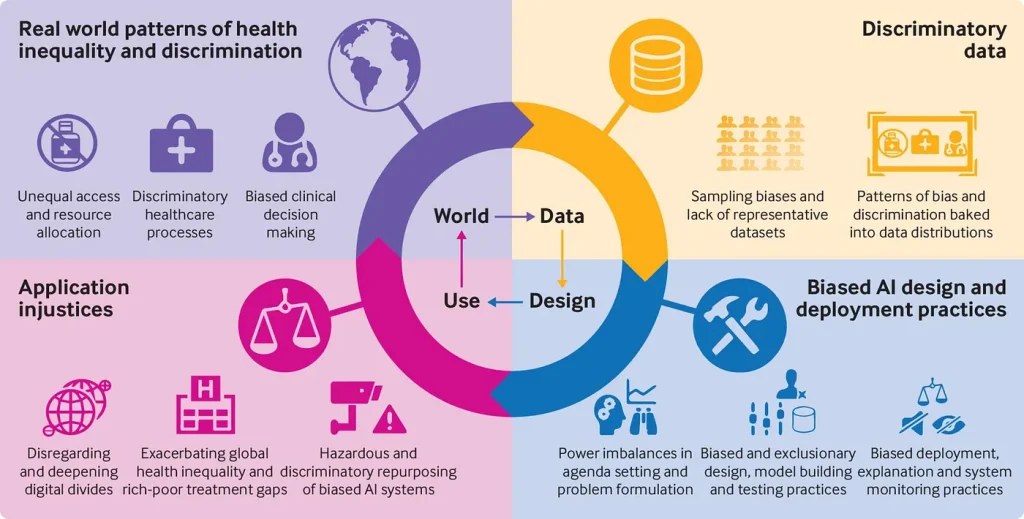
AI bias isn’t a hypothetical concern — it has shown up repeatedly in deployed systems:
- Hiring algorithms that downgraded resumes containing the word “women’s,” reflecting historical hiring imbalances in the training data.
- Facial recognition systems that have shown significantly higher error rates when identifying women and people with darker skin tones compared to lighter-skinned men.
- Credit scoring models that have been found to offer less favorable terms to applicants from historically underserved neighborhoods.
- Healthcare algorithms that under-prioritized care recommendations for certain racial groups due to biased historical cost data used as a proxy for medical need.
These examples share a common thread: the AI wasn’t intentionally designed to discriminate, but the data and assumptions behind it carried forward real-world inequities.
How Organizations Can Reduce AI Bias
While eliminating bias entirely is extremely difficult, several practical strategies can significantly reduce its impact:
- Diverse and representative training data: Ensuring datasets reflect the full population a system will serve.
- Bias audits and fairness testing: Regularly evaluating model outputs across different demographic groups before and after deployment.
- Transparent documentation: Clearly recording how data was collected, what assumptions were made, and what limitations exist.
- Human oversight: Keeping humans involved in high-stakes decisions rather than fully automating outcomes with legal or ethical consequences.
- Diverse development teams: Including people with varied backgrounds and perspectives in the design and testing process, since blind spots are often easier to catch from an outside viewpoint.
Why This Matters for Everyone, Not Just Developers
AI bias isn’t just a technical problem — it’s a societal one. As AI systems increasingly influence hiring, lending, healthcare, and law enforcement decisions, biased outcomes can have real, lasting consequences for people’s lives. Being an informed user or consumer of AI-powered tools means understanding that “the algorithm said so” is not the same as “the algorithm is fair.” Asking how a system was trained, tested, and audited is a reasonable and increasingly necessary question, whether you’re a business leader adopting new AI tools or simply a consumer interacting with automated decision-making.
If this exploration of AI fairness resonated with you, our other articles dig deeper into the technical and ethical dimensions of building trustworthy AI — from how neural networks actually learn to how predictive algorithms shape everyday consumer experiences. Reading further will help you build a fuller, more critical understanding of the systems increasingly shaping modern life.
Conclusion
AI bias is not a flaw introduced by malicious intent, it’s a natural consequence of training systems on imperfect, historically skewed data without sufficient safeguards. From imbalanced datasets to biased labeling and flawed feature selection, bias can enter an AI system at multiple points along its development pipeline, often invisibly. Addressing it requires deliberate effort: diverse data, rigorous testing, transparency, and ongoing human oversight. As AI continues to shape decisions in hiring, healthcare, finance, and beyond, understanding how bias forms and how it can be mitigated is essential for building systems that are not just intelligent, but genuinely fair. Continue exploring our website for more articles that unpack the technology and ethics shaping the future of artificial intelligence.
Frequently Asked Questions (FAQ)
1. Can AI ever be completely free of bias?
Not entirely. Since AI learns from human-generated data, some level of bias risk will always exist, but it can be significantly reduced through careful data practices and ongoing testing.
2. Is AI bias always intentional?
No. Most AI bias arises unintentionally from imbalanced data, flawed labeling, or unexamined assumptions rather than deliberate discrimination.
3. How can everyday users spot potential bias in AI tools?
Look for transparency about how a system was trained and tested, and be cautious of tools that provide little explanation for how their decisions or recommendations are made.
References
- Gumilar, A., Prasetiyowati, S. S., & Sibaroni, Y. (2022). Performance analysis of hybrid machine learning methods on imbalanced data (rainfall classification). Jurnal RESTI (Rekayasa Sistem dan Teknologi Informasi), 6(3), 481–490. https://doi.org/10.29207/resti.v6i3.4142 (Corresponding author verified on institutional record, Telkom University, email domain: telkomuniversity.ac.id)
- Barocas, S., Hardt, M., & Narayanan, A. (2023). Fairness and Machine Learning: Limitations and Opportunities. MIT Press.
- Kearns, M., & Roth, A. (2021). The Ethical Algorithm: The Science of Socially Aware Algorithm Design. Oxford University Press.
- Coeckelbergh, M. (2022). AI Ethics (Updated ed.). MIT Press.
- Telkom University Open Library. (2023). Machine Learning dan Deep Learning. Telkom University Press. https://openlibrary.telkomuniversity.ac.id/pustaka/231311/machine-learning-dan-deep-learning.html