
In the era of digitalized higher education, an institution’s visibility on the internet has become a reflection of its academic quality and scientific contribution. One of the most established ranking systems that consistently measures this aspect is Webometrics.
What is Webometrics?
Webometrics, officially known as the Ranking Web of Universities, is a global university ranking system that assesses higher education institutions based on their academic activities, online visibility, and the impact of their scholarly publications through digital presence.
Unlike many traditional university rankings, Webometrics combines webometric and bibliometric indicators to measure the influence and accessibility of knowledge produced by universities. Its primary objective is to encourage institutions to promote Open Access to research outputs and academic resources, making them widely available to society.
In addition, Webometrics serves as an evaluation tool that enables universities to measure their competitiveness and academic performance compared to other institutions at both national and international levels.
The Evolution of Webometrics Ranking
2004–2011: The Beginning of Webometrics
Webometrics was established in 2004 by Isidro F. Aguillo and the Cybermetrics Lab, a research group under the Spanish National Research Council (CSIC).
During this period, the internet was rapidly becoming an essential medium for sharing information and research findings. Webometrics emerged to complement existing ranking systems, many of which primarily focused on universities in the United States and Europe.
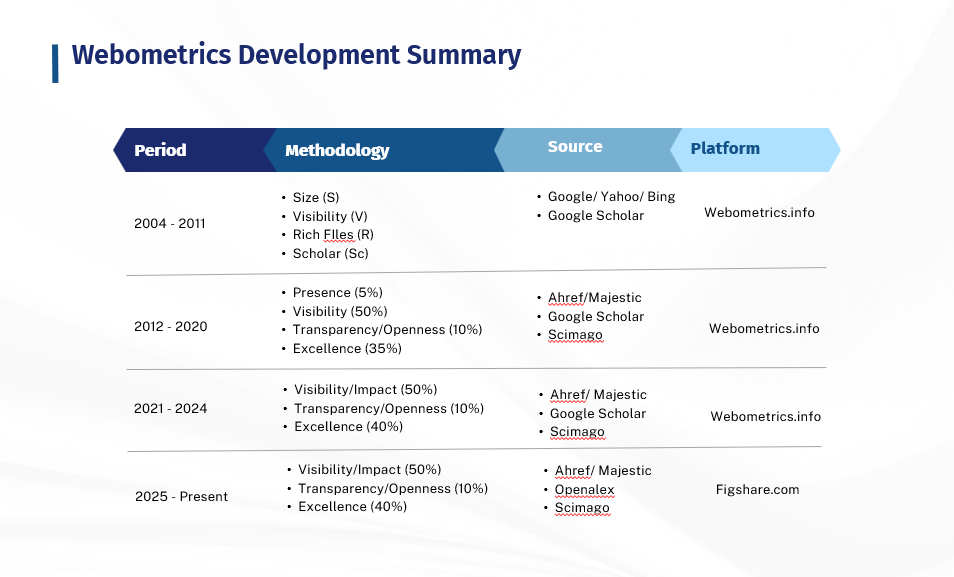
From its inception, Webometrics sought to evaluate tens of thousands of universities worldwide objectively by utilizing data from search engines such as Google, Yahoo, and Bing, as well as Google Scholar. Ranking results were published through the Webometrics platform, webometrics.info.
During this period, the ranking methodology was based on four indicators:
- Size (S)
- Visibility (V)
- Rich Files (R)
- Scholar (Sc)
2012 – 2020: Methodological Refinement
Between 2012 and 2020, Webometrics introduced significant methodological changes to provide a more accurate representation of university performance in the digital era.
The ranking system was structured around four main indicators:
- Presence (5%)
- Visibility (50%)
- Transparency atau Openness (10%)
- Excellence (35%)
To support these indicators, Webometrics utilized several trusted data sources:
- Ahrefs and Majestic for website visibility analysis
- Google Scholar for evaluating academic openness
- Scimago for measuring research impact and quality
2021 – 2024: Greater Focus on Research Impact
In 2021, Webometrics further refined its methodology to emphasize academic impact and research quality. One of the most notable changes was the removal of the Presence indicator, meaning that the number of webpages indexed under a university domain was no longer considered in the ranking process.
As a result, the weighting of the remaining indicators was adjusted as follows:
- Visibility/Impact (50%)
- Excellence (40%)
- Transparency/Openness (10%)
This shift demonstrated Webometrics’ commitment to prioritizing quality over quantity in evaluating university performance.
2025–Present: Open Science and Data Transparency
Since 2025, Webometrics has maintained its focus on assessing institutional quality, research impact, and academic openness. However, an important change was introduced regarding data sources. For the Transparency/Openness indicator, Webometrics replaced Google Scholar with OpenAlex as its primary source of academic data.
OpenAlex is an open scholarly database that provides comprehensive information on publications, authors, institutions, and citations. This transition was implemented to improve data accuracy, transparency, and sustainability in the ranking process.
In addition to the change in data sources, starting this period, Webometrics will no longer use webometrics.info as its platform for publishing and presenting ranking data, instead switching to the figshare.com platform. This decision is also supported by an official statement from Isidro F. Agullio, announced on the platform in January 2026.
On figshare.com, access to Webometrics’ global ranking data is limited. Only the first-place ranking for each country is publicly announced.
Baca juga: Kampus Terbaik di Indonesia Versi Webometrics Januari 2026
Current Webometrics Methodology
According to the latest methodology, Webometrics evaluates universities using three core indicators:
| Visibility | Web contents impact | 50% | Number of external inlinks from different networks (subnets) to the main university domain |
| Excellence | Top cited papers | 40% | Measures the number of scientific publications ranked among the top 10% most-cited papers across 27 academic disciplines during the evaluation period. |
| Openness | Total citations | 10% | Measures institutional citation performance based on OpenAlex data for institutions with a Research Organization Registry (RoR) identifier. |
Conclusion
The evolution of Webometrics demonstrates its continuous adaptation to the changing landscape of digital scholarship. By adopting more open, transparent, and modern data sources, Webometrics has evolved from a web-based visibility ranking into a comprehensive assessment of research quality, academic openness, and institutional competitiveness on a global scale.
Referensi
Cybermetrics Lab. (2026). Ranking Web of Universities (webometrics.info): January 2026 edition [Preprint]. Figshare. https://doi.org/10.6084/m9.figshare.31132501
FAQ
1. What is the main difference between Webometrics and other ranking systems such as QS or THE?
Answer:
The primary difference lies in the evaluation methodology. While ranking systems such as QS World University Rankings and Times Higher Education (THE) rely significantly on reputation surveys and other qualitative assessments, Webometrics focuses on webometric and bibliometric indicators. Webometrics evaluates how effectively a university disseminates its research and academic outputs through digital platforms, as well as the impact of that content on the global community through Open Access initiatives.
2. Why does the Visibility indicator have the highest weight (50%) in the ranking methodology?
Answer:
The Visibility, or Impact, indicator carries the largest weight because it reflects external recognition of a university’s digital content and academic contributions. The number of external backlinks pointing to a university’s domain is considered evidence that its research outputs, publications, and academic resources are valuable and frequently referenced by other institutions, organizations, researchers, and individuals worldwide
3. How can institutions access the latest Webometrics ranking data?
Answer:
The latest edition of the Webometrics Ranking is published through figshare.com and can be accessed by the public. However, the publicly available datasets generally provide limited information and typically display only the top-ranked institution in each country.
Institutions that require more comprehensive data—including rankings beyond the top institution, detailed indicator scores, or more extensive datasets—must submit an official request to Isidro F. Aguillo through the authorized paid access channels provided by Webometrics.
Writer: Bertha Nathalia C. P | Editor: Dian Eka Fitriani